Building a System-Led Landscape Company
For years, the landscape industry has eagerly adopted new technology designed to make project management easier. From high-end quoting software and scheduling platforms to specialized landscaping CRM and accounting packages, these digital tools are now common across the sector.
However, while software has undoubtedly improved individual tasks, it hasn’t solved the core challenge facing owners today: the “owner bottleneck.” The reality is that true growth doesn’t come from a new app—it comes from robust landscape business systems that allow a company to function independently of its founder.
The Critical Difference Between Software and Systems
To scale a landscape company sustainably, you must understand that software and systems are not the same thing.
Software is a tool that helps you perform a task. A CRM records a lead; an accounting package tracks an invoice.
Systems are the “logic” behind the tool. They define how you qualify a lead, how you structure a profitable proposal, and how your crews deliver a consistent result every single time.
Without clear landscape business systems, software simply helps you repeat inefficient, manual processes faster. A system ensures that the business operates consistently, whether you are on the job site or on holiday.
The Hidden Cost of the Owner Bottleneck
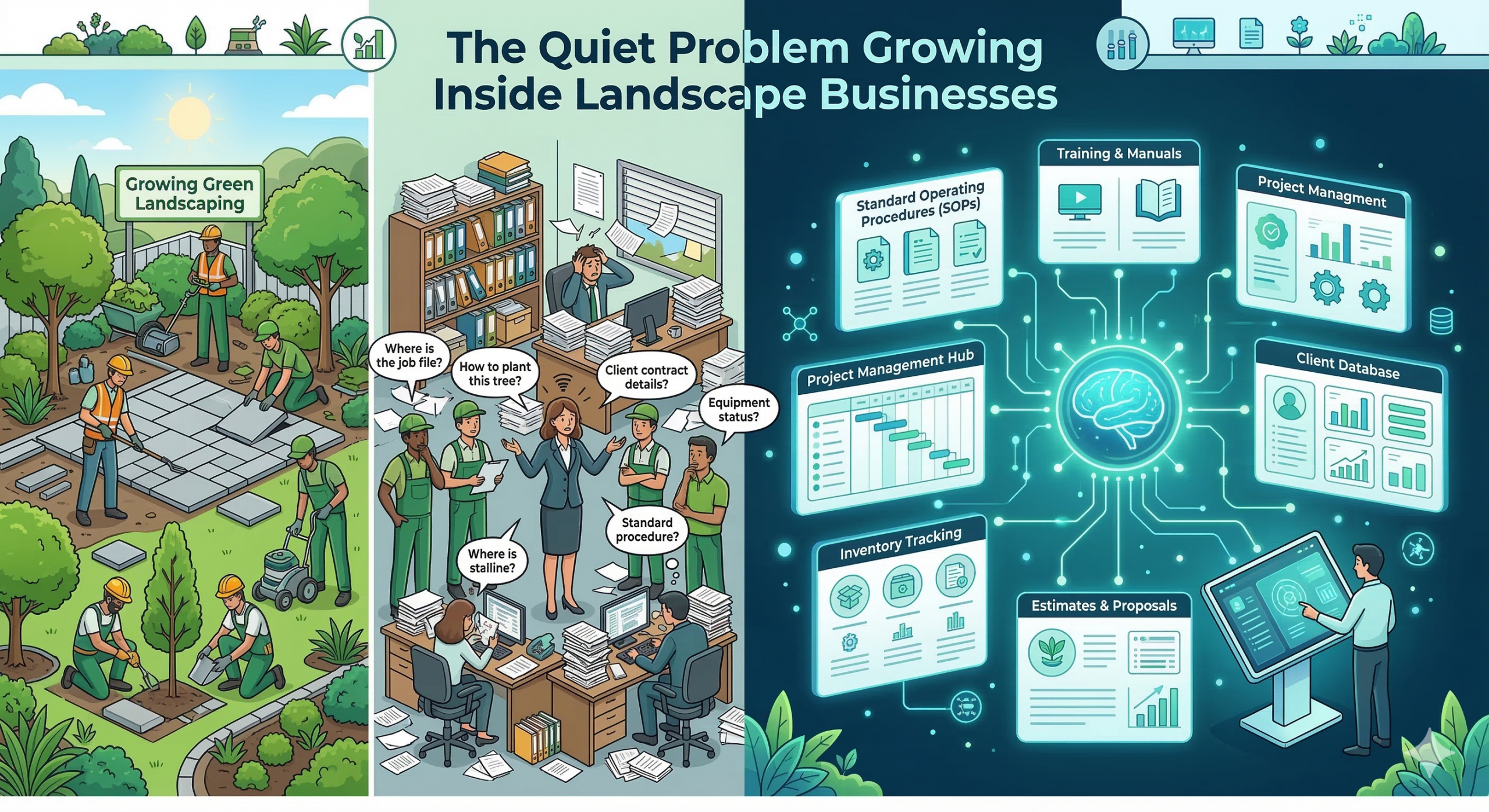
Most landscaping firms start with a skilled craftsman. As demand grows, teams are hired, but the “business intelligence” remains trapped in the owner’s head. This creates an informal environment where pricing, sales, and operations rely on the owner’s memory and instinct.
As you attempt scaling a landscape company, this lack of structure creates immense pressure:
• Inconsistent Sales: Every enquiry is handled differently depending on who answers the phone
• Pricing Drift: Quotes are based on “gut feeling” rather than a standardized data model
• Operational Friction: Teams resolve issues differently, leading to varied quality and wasted materials
• Training Fatigue: New staff take longer to onboard because there is no “Company Playbook” to follow
How AI is Revolutionising Landscape Business Systems
Historically, building formal systems required expensive consultants or months of manual documentation. In 2026, Artificial Intelligence has changed the game, making landscape business automation accessible to small and medium firms.
1. Moving from Reactive to Proactive with AI Coaching
An AI Coach acts as a strategic partner, helping you design the very frameworks your business needs. Instead of solving the same problems repeatedly, an AI Coach helps you build a system so the problem never occurs in the first place.
2. Standardising Operations with AI Assistants
Building a “Standard Operating Procedure” (SOP) used to be a chore. Now, an AI Assistant can help you document your pricing logic, site safety protocols, and marketing workflows in a fraction of the time. This transforms your “hidden” knowledge into a tangible asset the whole team can use.
3. Enhancing Consistency with AI Sales Agents & Chatbots
• AI Sales Agents: Ensure every lead is qualified and booked using your specific criteria, 24/7
• Custom AI Chatbots: Act as your company’s “Internal Brain.” Teams can ask the chatbot about material specs or pricing rules, getting instant answers based on your expertise without interrupting your day.
Building Better Teams Through Systematic Insight
Systems also extend to your most valuable asset: your people. By utilising an AI Team Dynamics Profiler, owners can move away from “panic hiring” and toward building resilient teams. When you combine clear landscape business systems with an understanding of behavioural traits, you create a culture of clarity and high performance.
The Future: A System-Led Landscape Company
The landscape industry will always be rooted in craftsmanship and physical expertise. Technology will never replace the beauty of a well-designed garden or the skill of a master stone-mason.
However, the businesses that thrive in the coming years will be those that treat their “back-office” with the same precision they bring to their landscapes. By implementing landscape business systems alongside your software, you create a company that can grow, maintain profitability, and operate with total consistency.