
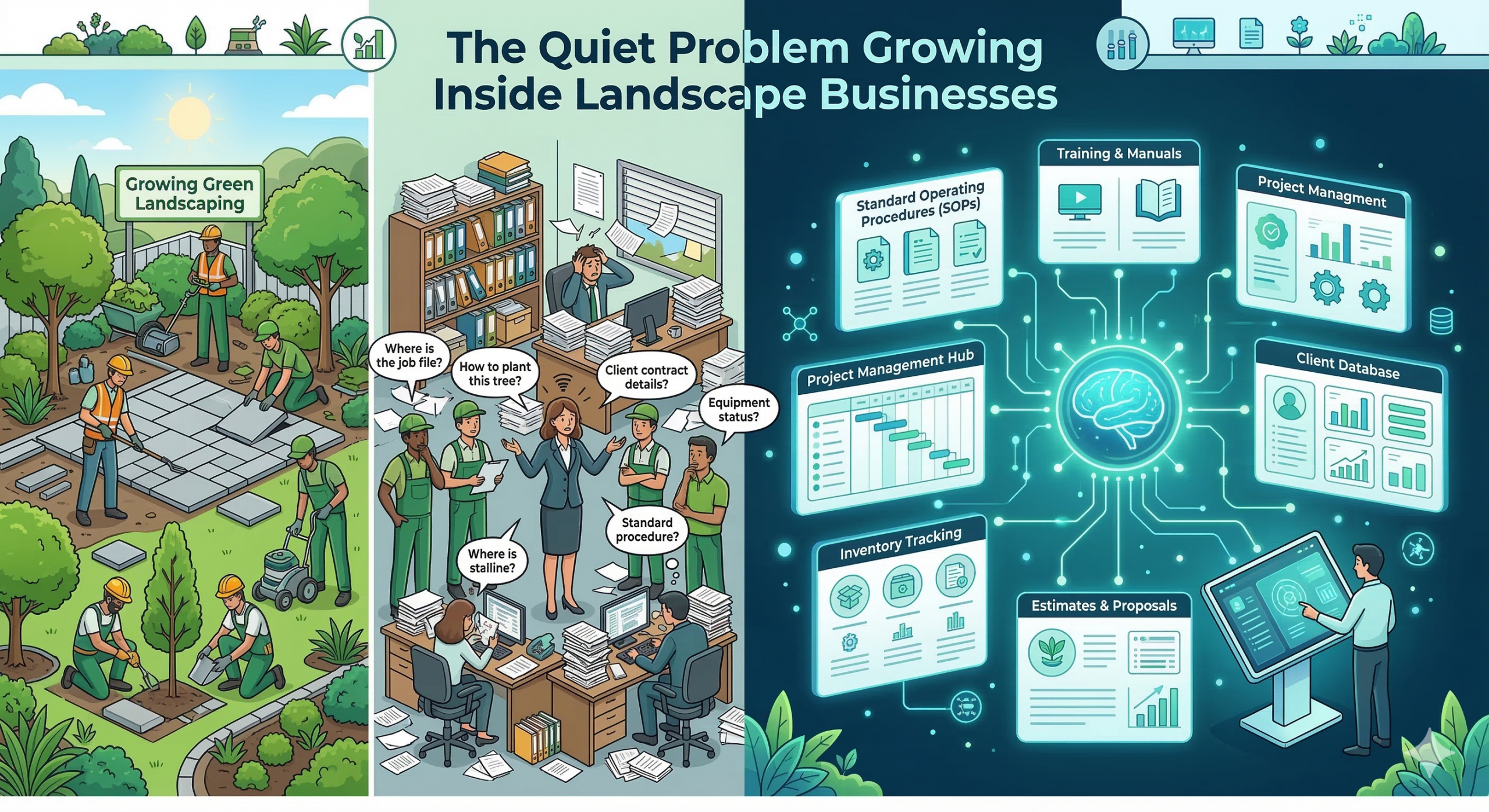
AI Knowledge Systems for Landscape Businesses: Solving the Hidden Growth Bottleneck The Quiet Problem Growing Inside Many Landscape Businesses Most
The landscape industry has spent decades perfecting the balance between art and nature. Over the past twenty years, we have seen design standards rise significantly, project complexity increase, and clients become far more sophisticated. To keep pace, successful firms have traditionally relied on better equipment and increasingly refined construction techniques.
However, a new structural shift is now unfolding. AI for landscape businesses is no longer a futuristic concept — it is quickly becoming a practical necessity for companies that want to scale effectively. While early perceptions positioned artificial intelligence as a tool reserved for large technology companies, it has rapidly evolved into an accessible solution for small and medium-sized landscaping firms.
This transition is not about replacing the human element of the craft. Gardens will always require the creative vision of a designer and the skilled hands of a builder. Instead, the transformation is taking place within the systems that support the business behind the scenes.
In the early stages of technological adoption, new tools are often viewed as optional. Many owners currently use AI in a fragmented way — perhaps using ChatGPT to draft a quick social media caption or respond to an email enquiry. While useful, these remain surface-level applications.
In other sectors, AI is already moving into the central nervous system of the company. This includes areas such as:
• Organising fragmented company data
• Supporting high-level leadership decisions
• Automating multi-channel communication
For businesses implementing AI for landscape businesses today, the objective is to move beyond simple tools and towards integrated intelligence.
Most landscape business owners experience a similar bottleneck: they become the single point of failure within the company. As the business grows, the owner often becomes the centre of every enquiry, pricing decision, and scheduling issue.
This model is not sustainable. When operational knowledge exists only in the owner’s head, the team remains dependent and the owner remains under constant pressure. Artificial intelligence offers a framework to distribute this “brainpower” across the entire organisation
.
One of the most valuable benefits of AI for landscape companies is the ability to regain time for strategic thinking.
An AI Business Coach can help analyse complex challenges — such as seasonal cash-flow fluctuations or equipment return on investment — by asking structured questions that clarify priorities. This type of support allows leaders to step away from daily operational “firefighting” and focus on long-term growth and strategic landscape business management.
Administrative tasks are often the silent profit killers within the green industry. Drafting proposals, documenting site work, and managing internal processes can easily consume dozens of hours each week.
• Proposal drafting: AI can generate structured bids based on historical pricing data
• Project documentation: Site notes and photos can be automatically organised into client-facing reports
• Operational FAQ systems: Field teams can access an AI assistant trained on your company’s safety protocols and installation standards
By integrating field service management enhanced with AI, teams can operate with greater clarity, allowing the owner to focus on high-value client relationships.
Responsiveness remains the number one factor in winning new contracts. However, when you are working on a job site, responding immediately to a web enquiry is often impossible.
AI Sales Agents can now manage the first point of contact around the clock. These systems can:
• Acknowledge an enquiry instantly
• Collect project details such as location, budget and timeline
• Book consultations directly into your calendar
This ensures a professional and high-speed sales process that prevents potential leads from going cold.
Every experienced landscaper carries a mental database of local soil types, preferred suppliers and practical construction shortcuts. The risk is that this knowledge disappears when the owner is unavailable.
Custom AI chatbots allow you to effectively capture and replicate this expertise. By integrating your pricing frameworks and operational documents into an internal system, your team can receive instant answers to questions such as:
• How should we price Grade A limestone in this area?
• What is our standard drainage protocol for clay-heavy soil?
This transforms individual experience into a scalable company-wide knowledge resource.
Industry trends for 2026 suggest a growing movement towards human-centric AI. The purpose of technology is not to replace people, but to empower them.
An AI Team Dynamics Profiler can help business owners better understand communication styles, leadership traits and collaboration patterns within their crews. By identifying how different personalities work together, companies can build stronger and more adaptable teams prepared for the evolving demands of the market.
Every industry eventually reaches a tipping point where new technology reshapes the competitive landscape. For the green industry, that moment is approaching rapidly.
AI for landscape businesses presents a powerful opportunity to organise systems, protect profit margins and reclaim the owner’s time.
The craftsmanship will always remain in the soil and the design. However, the companies that thrive will be those built on a smarter, faster and more efficient digital foundation.
Frequently Asked Questions
AI can support small landscape businesses by automating repetitive tasks such as lead responses, scheduling and proposal drafting. This allows the owner to focus on billable work and creative design rather than becoming trapped in administrative bottlenecks.
No. AI is a tool that can support design processes by analysing data and generating ideas. However, it cannot replicate the human creativity, site-specific judgement and client understanding required for high-end landscape architecture.
An AI Sales Agent is an automated system that communicates with potential clients through your website or email. It qualifies leads by asking questions about project scope and budget and can even schedule consultations, ensuring your business remains responsive at all times.
The most effective approach is to begin small. Many businesses start by using AI tools for tasks such as content creation or handling initial enquiries.
Over time, the focus can shift towards capturing company knowledge by building an internal database. This allows your team to access company-specific pricing structures and operational procedures through a private AI assistant, ensuring faster decision-making and greater operational consistency.
Share This Post
AI Knowledge Systems for Landscape Businesses: Solving the Hidden Growth Bottleneck The Quiet Problem Growing Inside Many Landscape Businesses Most
AI for Landscape Businesses: How Landscaping Companies Can Adapt and Scale in the AI Era The AI Shift: Why Modern

AI for Landscape Businesses: How Intelligent Systems Are Transforming and Scaling Landscaping Companies The AI Turning Point for Landscape Businesses
“Ask How AI Could Improve Your Landscape Business”