AI in the Landscape Industry: Strengthening Business Systems
For decades, the landscape sector has evolved through a familiar, time-honoured path. Success was built on reputation, local craftsmanship, and the power of word-of-mouth. Business owners managed their teams, pricing, and project delivery using a mix of hard-earned experience and gut instinct.
While these foundations remain the heart of the trade, the “behind-the-scenes” reality is shifting. AI in the landscape industry is moving from a high-tech talking point into a practical suite of tools that small and medium-sized firms use every day. What once felt like an experiment is now accessible, affordable, and essential for staying competitive.
Strengthening the Systems, Not Replacing the Craft
It is important to clarify: this shift is not about replacing the professional landscaper. Landscaping is fundamentally a hands-on, creative profession. Designing a garden or constructing a complex hardscape requires technical understanding and physical skill that artificial intelligence cannot replicate.
However, running a business involves much more than what happens on-site. Owners are responsible for:
• Managing enquiries and qualifying leads
• Pricing work accurately to protect margins
• Organising crews and project timelines
• Making strategic decisions about the company’s future
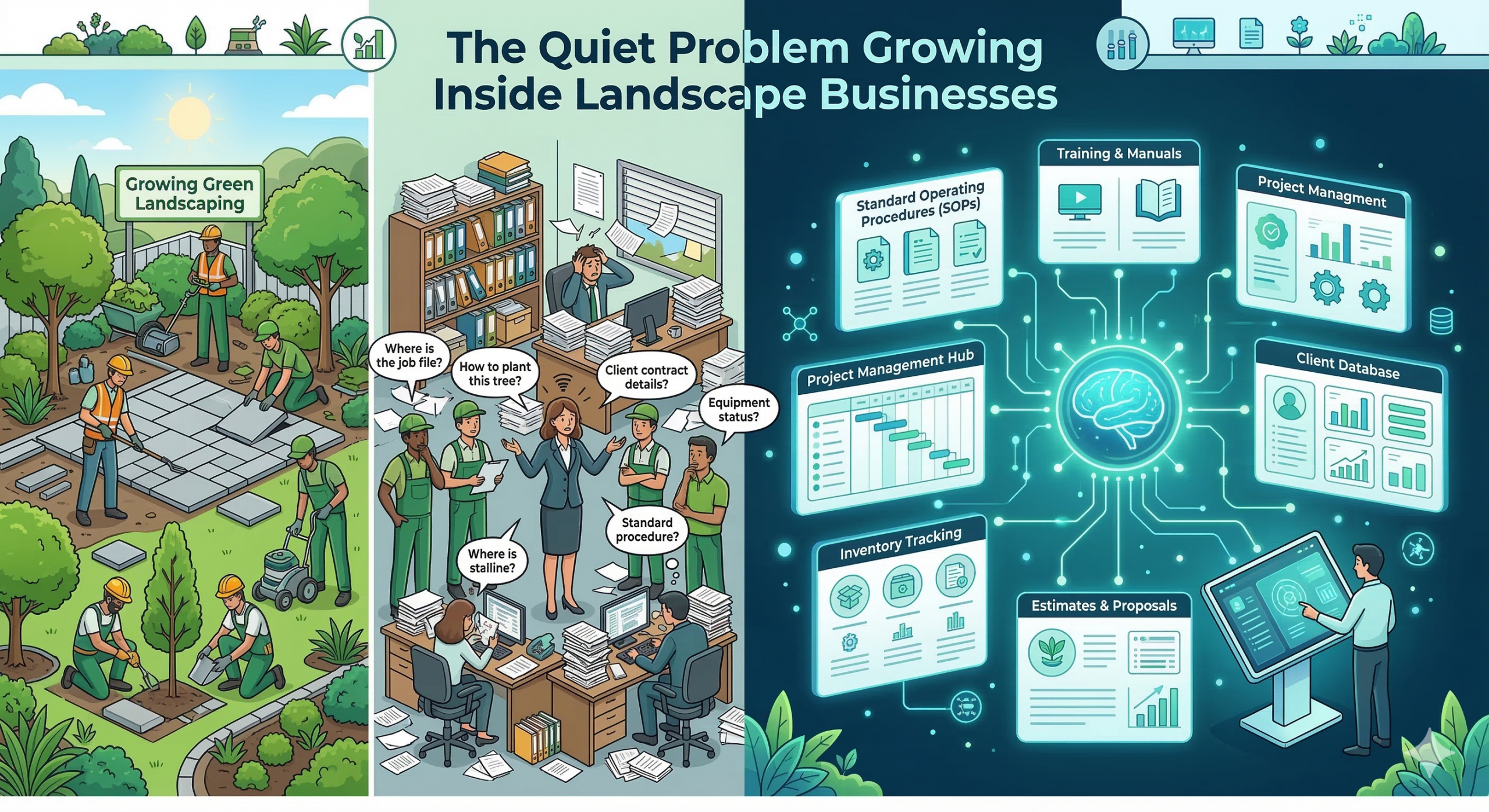
In many companies, these burdens fall solely on the owner. As you grow, this “owner bottleneck” becomes a barrier to scaling. This is exactly where AI in the landscape industry is making its biggest impact—by strengthening the systems that support the craftsman.
How AI in the Landscape Industry Supports Business Growth
1. Strategic Decision Support (The AI Coach)
Running a landscape company requires constant high-stakes decisions regarding hiring, equipment investment, and marketing. Most owners make these choices in isolation.
An AI Coach acts as a strategic thinking partner. It helps you analyse complex situations, explore different growth options, and clarify your priorities. This moves you away from reactive “firefighting” and toward a deliberate, structured business strategy.
2. Streamlining Daily Operations
The “admin tax”—preparing proposals, documenting site systems, and drafting marketing content—can consume hours of a business owner’s week.
Modern landscape business automation tools, such as an AI Assistant, can now handle:
• Proposal Generation: Creating professional quotes from site notes instantly
• System Documentation: Recording standard operating procedures (SOPs) so your teams know exactly how to perform tasks without asking you
• Marketing Content: Generating SEO-optimised blog posts and social media updates to keep your brand visible
3. Revolutionising Sales with AI Sales Agents
The biggest “silent killer” of growth is a slow response to a lead. If a client reaches out while you are on-site, they may have called three other companies by the time you check your email.
AI Sales Agents bridge this gap by responding to enquiries 24/7. They can:
• Qualify potential clients based on budget and location
• Schedule consultations directly into your calendar
• Ensure no opportunity is lost due to a busy schedule
Capturing Your “Company Brain”
One of the most valuable benefits of digital transformation in landscaping is the ability to capture institutional knowledge. Often, the “secret sauce” of your pricing or service standards is trapped in your head.
Custom AI Chatbots can be trained on your internal processes, acting as a searchable intelligence resource for your team. Instead of repeatedly calling you for answers, your crew can consult the company’s AI system for guidance on everything from plant care to paving standards.
Building Stronger Teams Through Data
Technology and human leadership must work in tandem. AI tools for landscapers, such as a Team Dynamics Profiler, help you identify behavioural patterns in your crew. This data-driven approach allows you to:
• Improve recruitment decisions
• Develop stronger leadership structures
• Maintain a positive, productive company culture
A Gradual but Essential Shift
The influence of AI in the landscape industry is still in its early stages, but the direction is clear. The businesses that combine elite craftsmanship with intelligent, well-organised systems are the ones that will scale most successfully.
Artificial intelligence will never change the fundamental joy of creating a beautiful outdoor space. However, it is fundamentally changing how the most successful landscape businesses organise themselves behind the scenes to reach their full potential.
Ready to explore the future of your business?