
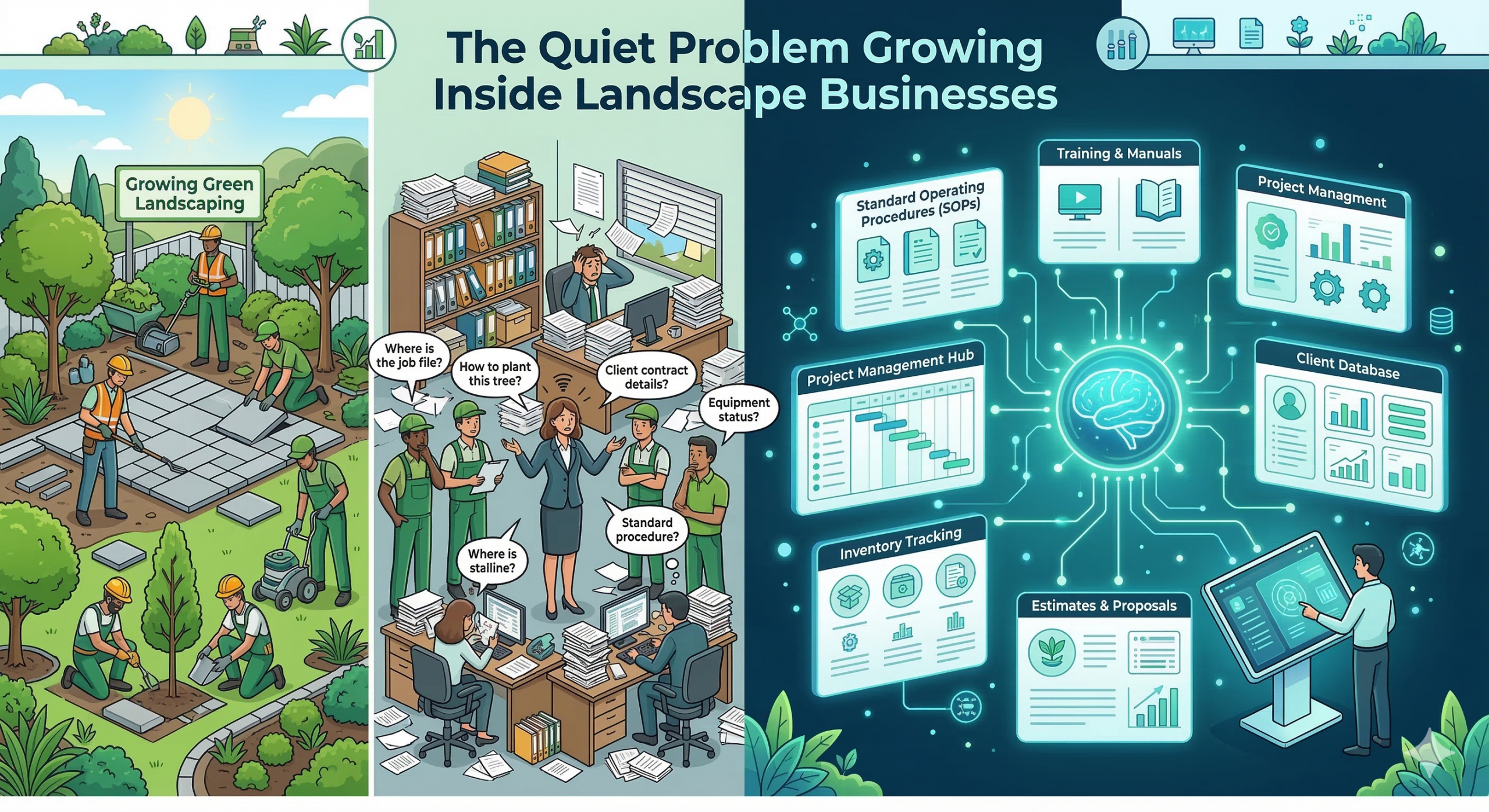
AI Knowledge Systems for Landscape Businesses: Solving the Hidden Growth Bottleneck The Quiet Problem Growing Inside Many Landscape Businesses Most
Most established landscape businesses eventually reach a stage where something interesting begins to happen. The company grows, projects become larger, teams expand, and systems begin to develop. On the surface, everything appears positive. More work is being won, more gardens are being built, and the business has genuine momentum.
Yet quietly, behind the scenes, a different kind of pressure often begins to emerge. It is usually not a problem with the landscaping itself. The teams know what they are doing, the quality of work on site is strong, and clients are happy. Instead, this pressure tends to stem from a bottleneck in modern landscape business management. This is precisely where the introduction of AI for landscape businesses is beginning to change things.
The core issue lies in the way knowledge flows within the business.
Over the years, every successful landscape company accumulates a significant amount of experience. As your landscaping operational procedures evolve, a number of highly valuable internal assets naturally develop:
• Pricing approaches and financial models become more refined
• Proposal structures improve to achieve better conversion rates
• Teams learn which materials perform best in specific climates or situations
• Supplier relationships become stronger and more reliable
• Construction techniques gradually improve through experience
The challenge is that much of this valuable internal knowledge often exists only in people’s heads.
The owner understands how certain projects should be priced. Someone in the office knows exactly how proposals are normally structured. A senior team member may have developed practical expertise regarding particular construction details. Important documents may exist somewhere, but accessing that knowledge is rarely straightforward.
As a result, a familiar pattern begins to develop. Team members spend time searching through folders, managers are interrupted to clarify decisions, and gradually the business owner becomes the quickest and most reliable source of answers. Over time, this creates friction and inefficiency within the organisation.
Expert insight: A business cannot scale beyond the owner’s capacity to answer questions. Genuine growth occurs when a company transitions from being people-dependent to system-dependent.
When landscape companies reach a rapid stage of growth, three clear warning signs tend to appear.
Team members repeatedly ask the same questions regarding pricing structures, proposal formats, or material recommendations. The knowledge exists, but it is not easily accessible to the team.
Important information often sits buried inside folders. Many businesses have templates, supplier information, and training materials stored on shared drives, yet people simply do not know where to find them.
Because so much experience sits with the owner, questions about pricing, processes, and client communication naturally flow upwards. Gradually, the business becomes dependent on individuals rather than systems.
Many businesses attempt to address this challenge by organising their documents more carefully. Shared drives are restructured, procedures are written down, and larger organisations may even build internal intranet systems.
While these approaches can certainly help, they rarely resolve the underlying challenge of improving landscape business efficiency.
Information may technically exist within the company, but that does not mean it is instantly accessible. People still need to know where to look, search through folders, and interpret the information they find. As a result, questions continue to circulate, and the reliance on senior staff remains.
Artificial intelligence is now beginning to change how businesses organise and access their internal knowledge. Instead of relying solely on complex folder structures, forward-thinking companies are building internal AI knowledge systems.
These systems function as an intelligent assistant trained specifically on the company’s own proprietary information.
Rather than searching through files, team members simply ask a question:
• An estimator might ask how the company typically structures design-and-build proposals
• A salesperson might confirm the pricing model for a particular type of project
• A site supervisor might check a construction detail or verify which materials are recommended for a retaining wall
The AI system retrieves the relevant information instantly using the company’s own processes and documentation. It functions somewhat like a traditional company intranet, but instead of navigating through pages of text, the team simply asks a question and receives an immediate and accurate response.
As a landscape business expands, the complexity of the organisation naturally increases. More projects are running simultaneously, and clear communication between the office and site becomes essential.
Without an internal knowledge base in place, growth can create significant pressure. Owners often find themselves answering questions throughout the day, and decision-making begins to slow.
An AI knowledge system allows your hard-earned experience to be captured and shared across the entire organisation. Team members gain faster access to guidance, decisions become more consistent, and managers experience far fewer interruptions.
None of this changes the fundamental nature of landscaping. The industry will always depend on skilled professionals designing and building exceptional outdoor spaces. Technology cannot replace craftsmanship, experience, or creative judgement.
However, the systems that support these businesses are evolving rapidly. Companies that organise their knowledge, document their processes, and build strong internal systems are far better positioned to scale with confidence.
For many established teams, adopting AI for landscape businesses will soon become one of the most valuable operational tools available.
These systems are most powerful in established businesses where knowledge already exists but has not yet been fully structured. If your company has multiple teams delivering projects, a growing office function, and an owner who is tired of answering the same questions, you may well be ready for a change.
If this sounds familiar, an internal AI knowledge system could make a significant difference to both your bottom line and your daily stress levels.
To help owners understand whether they are ready to implement this technology, we have created a short readiness assessment. It takes only a few minutes and provides a score showing exactly how prepared your business is for the future.
Frequently Asked Questions
AI can support landscape businesses by acting as an internal knowledge base. It provides instant answers to employee questions about pricing, materials and standard operating procedures, reducing interruptions for the business owner and allowing the team to work more efficiently.
An internal knowledge system is a centralised platform — often powered by artificial intelligence — that stores a landscaping company’s documents, templates and operational procedures. It enables staff to retrieve information instantly without needing to search through complex folders or multiple systems.
Scaling a landscaping business efficiently requires moving away from owner-dependent decision-making and implementing strong internal systems. By capturing company knowledge in an accessible format, businesses can ensure that as the team grows, the quality, consistency and efficiency of work remain high.
Share This Post
AI Knowledge Systems for Landscape Businesses: Solving the Hidden Growth Bottleneck The Quiet Problem Growing Inside Many Landscape Businesses Most
AI for Landscape Businesses: How Landscaping Companies Can Adapt and Scale in the AI Era The AI Shift: Why Modern
AI for Landscape Businesses: How Intelligent Systems Are Transforming and Scaling Landscaping Companies The AI Turning Point for Landscape Businesses
“Ask How AI Could Improve Your Landscape Business”