The Rise of AI Operating Systems in Landscape Businesses
Across the green industry, a sophisticated new phrase is beginning to take hold in boardrooms and site offices alike: AI operating systems. Rather than using artificial intelligence as an occasional tool for drafting emails or generating social media content, forward-thinking business owners are embedding AI for landscape businesses into their core infrastructure.
When this shift takes place, AI moves beyond novelty and becomes the digital backbone of the company — supporting decision-making, client communication and knowledge management simultaneously.
The Shift from Isolated Tools to a Connected AI Operating System
Many owners have already experimented with basic landscape business automation, often using tools such as ChatGPT for marketing content. However, relying on standalone tools is comparable to using a calculator — whereas an operating system is the entire computer.
In a modern business environment, an AI operating system coordinates every moving part. It connects your sales pipeline to project delivery, ensures internal knowledge is accessible to every team member, and creates a unified environment where strategic thinking and daily operations exist side by side.
Why Landscape Businesses Need Intelligent Infrastructure
Landscaping requires a complex balance between high-level design and practical on-site execution. Even smaller firms must manage multiple responsibilities at once, including:
• Lead intake and qualification
• On-site consultations and pricing
• Complex project management and logistics
• Internal team communication
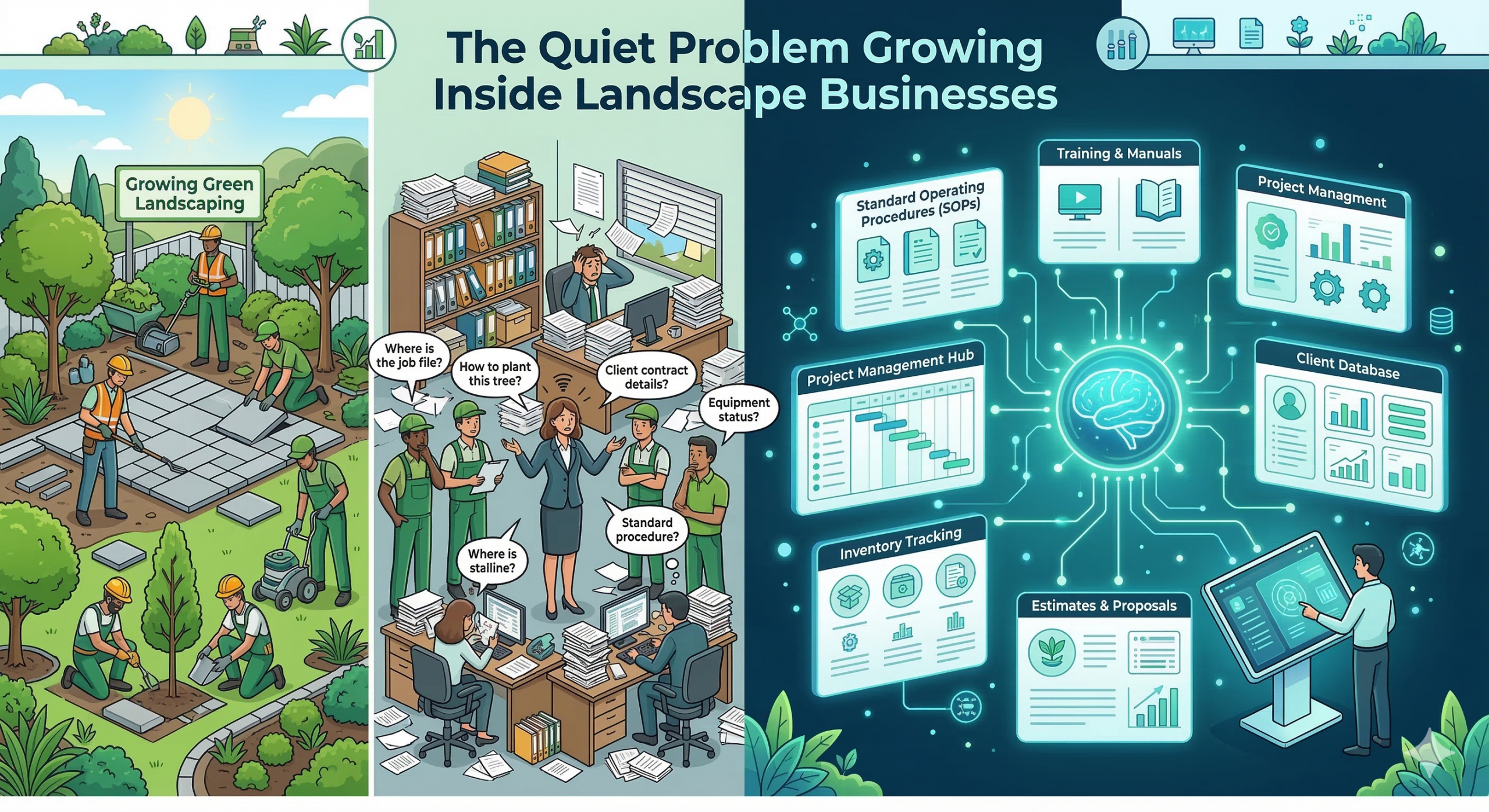
In traditional business models, much of this operational flow exists within the owner’s head. As the company grows, this level of founder dependency becomes a clear limitation.
By implementing AI-driven project management for landscapers, businesses can transition from relying on individual memory to operating through a scalable and intelligent system.
Strategic Decision Support: The AI Coach
One of the most transformative aspects of AI for landscape businesses is the clarity it brings to strategic decision-making.
An AI Coach can function as a high-level advisor, helping business owners analyse financial challenges, evaluate growth opportunities and explore different scenarios. Rather than navigating industry pressures in isolation, leaders can use structured AI frameworks to assess their business from multiple perspectives, leading to more informed and long-term decisions.
Streamlining Operations with an AI Assistant
Daily administrative work is often where profit margins are quietly eroded. From drafting proposals to organising internal procedures, the volume of paperwork can quickly become overwhelming.
A dedicated AI assistant for landscaping businesses can:
• Draft detailed client proposals in seconds
• Organise standard operating procedures (SOPs)
• Respond to routine operational queries from field teams
This level of digital support allows leadership teams to focus on high-value client relationships rather than becoming absorbed in administrative tasks.
Revolutionising Lead Flow with AI Sales Agents
Maintaining consistent sales activity remains a major challenge within the green industry. Enquiries are often missed simply because teams are working on-site or managing active projects.
AI Sales Agents address this issue by providing continuous, 24/7 responsiveness. These systems can:
• Respond to enquiries instantly
• Qualify leads based on project requirements
• Answer initial pricing-related questions
• Schedule consultations directly into your calendar
This ensures your sales pipeline remains active and no potential opportunity is lost.
Capturing Institutional Knowledge Through Custom Chatbots
Years of experience in pricing strategies, material selection and construction techniques represent some of the most valuable assets within a landscaping business. However, this form of “tribal knowledge” is often lost when key individuals are unavailable or leave the company.
Custom AI chatbots for landscaping businesses allow you to capture and retain this expertise. By integrating your internal documents and operational processes, team members can quickly access accurate information, transforming individual knowledge into a permanent organisational asset.
Building Stronger Teams with Predictive Insights
The final element of AI for landscape businesses focuses on people.
Using an AI Team Dynamics Profiler, business owners can gain deeper insight into communication styles, leadership tendencies and team collaboration patterns. By aligning individuals with roles that suit their strengths, companies can build more resilient and effective teams.
This ensures that your human operating system is just as optimised as your digital infrastructure.
The Era of the AI-Driven Landscape Firm
We are entering a new phase in the industry, where traditional craftsmanship is supported by intelligent systems.
By integrating tools such as an AI Coach, AI Assistant, Sales Agent and internal Knowledge Base, businesses are no longer simply adopting technology — they are building a fully integrated operating environment.
AI for landscape businesses does not replace the designer or the builder. Instead, it enables them to grow with confidence while stepping away from the constant demands of day-to-day micromanagement.