Why Scaling a Landscape Business Becomes So Difficult
Many landscape businesses begin with a simple and solid foundation. A skilled professional starts taking on projects, delivers excellent craftsmanship, and gradually builds a strong reputation. Word of mouth spreads, enquiries increase, and over time the business grows.
At first, this growth feels natural and encouraging. More projects create more opportunity, and many owners expand their teams to meet demand. However, there often comes a point where it becomes significantly more difficult to scale the business effectively.
The company may still be busy, but further expansion begins to feel increasingly complex. Owners find themselves working longer hours, dealing with constant operational issues, and feeling responsible for every decision. If this sounds familiar, you are not alone — this is one of the most common plateaus within the green industry.
The Complexity Gap: Why Quality Alone Is Not Enough
The challenge is rarely the quality of the landscaping work itself. In fact, most businesses reach this stage precisely because they are good at what they do. Instead, the difficulty lies in the structural “debt” within the business behind the scenes.
Understanding why these challenges occur is the first step towards building a sustainable and scalable company.
1. Growth Increases Operational Complexity
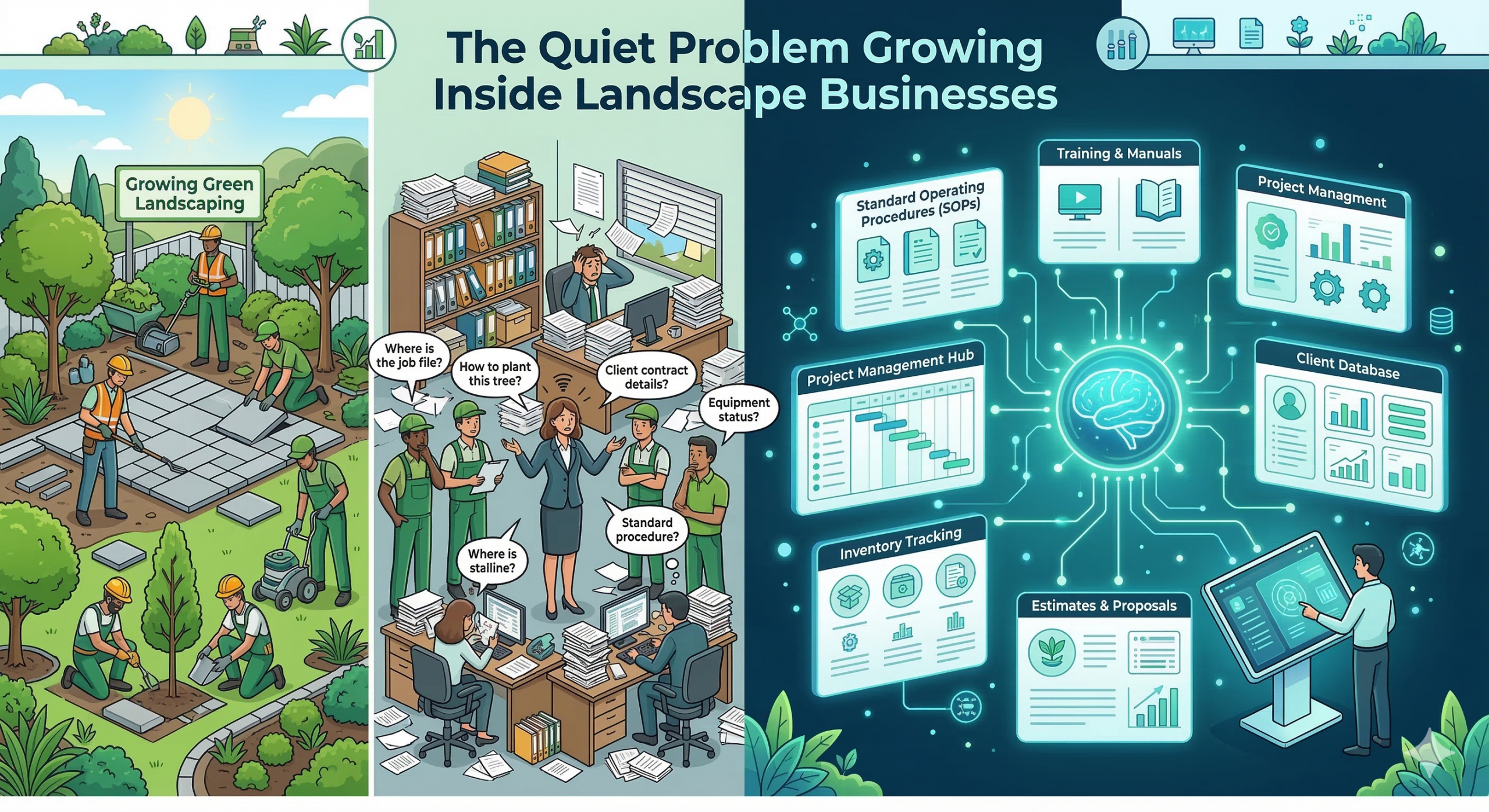
When a landscaping business is small, the owner typically manages everything directly. They meet clients, price projects, organise the team, and ensure the final finish meets expectations. Because the operation is small, this model can work effectively.
However, as you begin to scale a landscape business, the number of moving parts increases significantly:
• Multiple projects running simultaneously across different locations
• Expanding field teams alongside administrative staff
• More complex material logistics and tighter scheduling requirements
• A growing need for consistent client communication
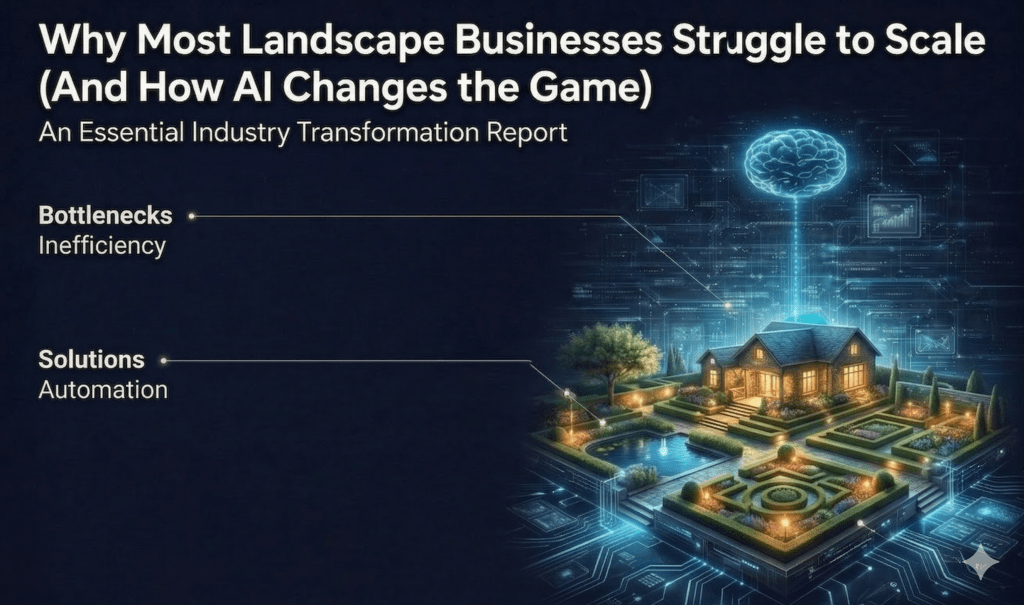
At this stage, the owner often becomes the primary bottleneck. Every important decision flows through them. While this may feel necessary to maintain quality, it ultimately creates a ceiling that limits growth.
2. The Hidden Role of Landscape Business Systems
One of the main reasons companies struggle to grow is the absence of clearly documented landscape business systems.
A system is simply a consistent and repeatable way of completing a task. It defines how:
• Enquiries are qualified and managed
• Proposals are structured and priced
• Projects are delivered on-site
• Teams communicate throughout the working day
In many businesses, these processes exist only in the owner’s mind. When team members attempt to complete tasks without a defined system, the outcome can vary each time.
This inconsistency often forces the owner back into a micromanagement role, slowing down overall growth.
3. How AI Is Transforming Landscaping Scalability
Traditionally, building internal systems and documentation required months of manual effort. Today, AI for landscapers is dramatically accelerating this process.
Capturing Knowledge with AI Assistants
An AI Assistant can help document processes in real time. Owners can describe how consultations are conducted or how specific technical issues are handled, and the AI can convert this information into clear and structured Standard Operating Procedures (SOPs).
Strategic Leadership and AI Coaching
To scale successfully, business owners must transition from being the person doing the work to the person leading the organisation.
An AI Coach can support this shift by helping analyse financial performance, assess hiring decisions and explore long-term strategy. This enables leaders to move from a reactive mindset to a more proactive and strategic approach.
4. Strengthening the Sales Pipeline and Team Dynamics
Scaling requires both a reliable flow of new work and a team capable of delivering consistently without constant oversight.
These systems ensure that no opportunity is missed by:
• Responding to enquiries instantly
• Collecting key project information
• Scheduling consultations automatically
This creates a consistent and predictable sales pipeline.
Custom AI Chatbots
Custom chatbots act as an internal company knowledge hub. Instead of contacting the owner for every query, team members can access immediate answers based on the company’s processes and data.
Team Dynamics Profilers
Scaling also requires distributing leadership responsibility. AI tools can help identify communication styles and strengths within your team, allowing you to build a more cohesive and effective workforce.
From Busy to Scalable: The Path Forward
Many landscape businesses are busy, but relatively few are truly scalable. The difference lies in the underlying infrastructure.
Businesses that rely entirely on the owner’s direct involvement will eventually reach a limit. By implementing structured systems and leveraging modern AI tools, you can organise your expertise and empower your team.
This transition does not change the craftsmanship that defines your brand — it simply creates the foundation for that craftsmanship to reach a wider audience.
If you are ready to move beyond being the bottleneck and step into the role of a true business leader, it is time to focus on the systems behind the scenes.
To scale a landscape business in today’s environment, adopting the right tools is essential — ensuring your business operates as efficiently as your best-managed project.