Making Better Decisions in a Landscape Business with AI
Running a successful landscape company involves making hundreds of important decisions every week. Some are relatively small operational adjustments, such as re-routing a crew due to weather conditions. Others are high-stakes strategic choices, including when to invest in heavy equipment, how to price a complex design-and-build project, or when to expand your team in an unpredictable market.
For many owners, AI for landscape businesses is emerging as a digital “thinking partner”. Most business owners spend their days on-site managing projects and their evenings dealing with administrative work. In this high-pressure environment, decisions are often based on instinct rather than structured data. AI is beginning to change this by introducing a more systematic framework for decision-making.
Why Decision-Making Becomes More Difficult as Your Business Grows
In the early stages of a landscaping business, decisions tend to be straightforward. You are present on every job, you know your clients personally, and your team is small and closely managed.
However, as the business grows, complexity increases significantly:
• Volume: More enquiries than can be manually assessed
• Scale: Projects move from simple maintenance to large-scale installations
• Management: Expanding teams require more advanced coordination
• Strategy: Marketing, recruitment and long-term investment must all be managed simultaneously
Without the right systems in place, decision fatigue becomes a real challenge. Important decisions are either delayed or made too quickly, without considering all available information. While experience remains invaluable, combining it with structured AI support leads to far more consistent outcomes.
Using AI to Structure Strategic Thinking
One of the most valuable applications of AI for landscape business owners is in long-term strategic planning.
An AI Business Coach enables a shift away from isolated problem-solving towards a more holistic view of the business. Rather than simply asking whether you can afford to hire, the AI can assess workload trends, seasonal demand and financial commitments to provide a more informed recommendation.
Key Strategic Benefits
• Pricing optimisation: AI can analyse labour costs, material fluctuations and target margins to suggest competitive and profitable pricing
• Risk assessment: Identify potential bottlenecks in your project pipeline before they develop into financial issues
• Scenario planning: Explore “what if” situations, such as expanding into new services or geographical areas
Supporting Operational Decisions and Efficiency
Beyond high-level strategy, AI also improves day-to-day operations.
An AI Assistant can provide immediate guidance based on your company’s documented systems and processes. For example, a crew leader on-site who needs clarification on a technical detail or communication protocol can access the information instantly, without needing to contact the owner.
This enhances operational efficiency and ensures that company standards are maintained, even when you are not physically present.
Capturing Knowledge to Scale Your Business
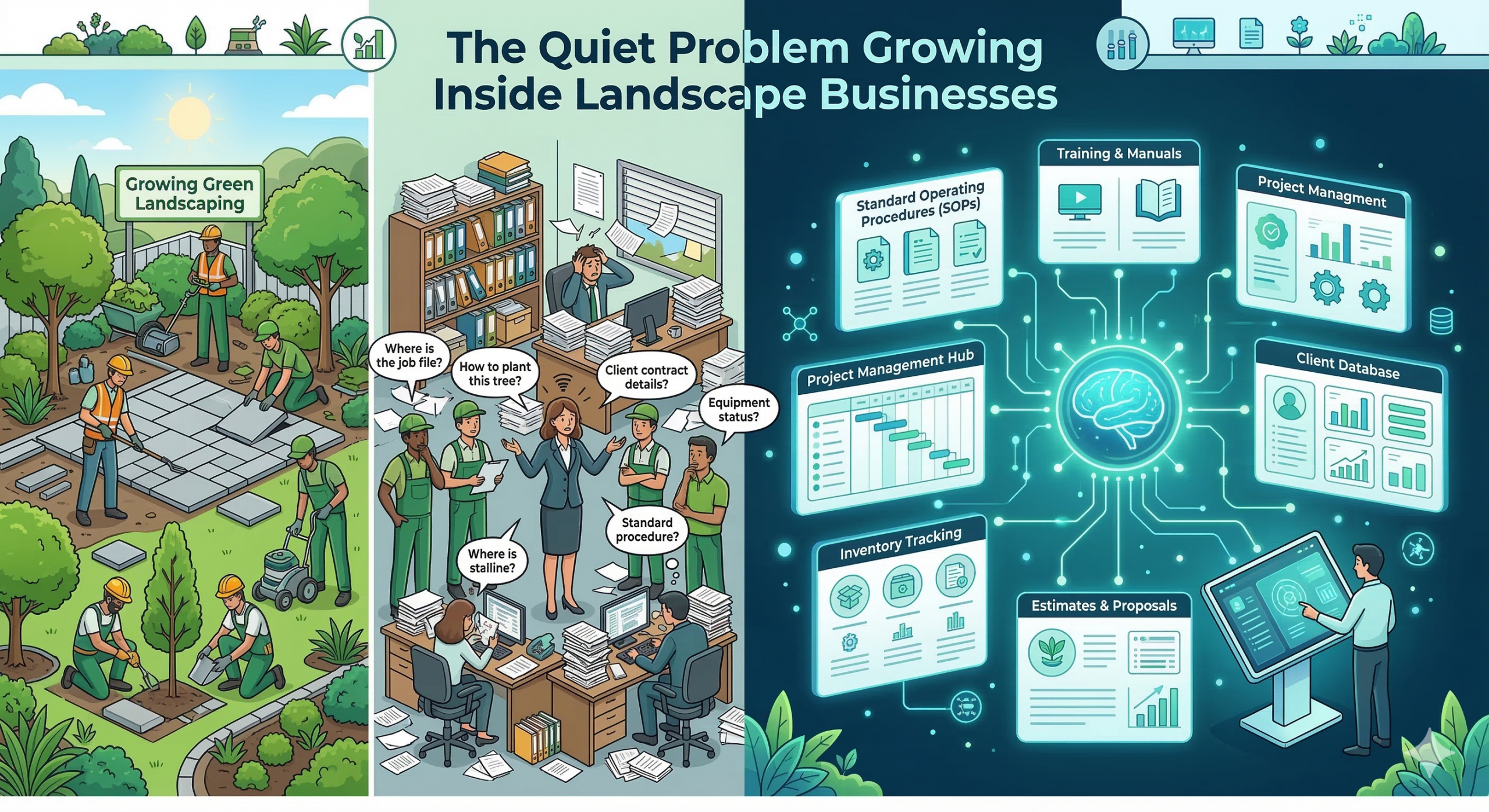
Many landscape businesses experience what is often referred to as founder dependency. Pricing strategies, supplier relationships and project methods exist primarily in the owner’s mind, making it difficult to scale effectively.
Custom AI chatbots act as a secure, centralised knowledge base for your business. By training a private AI system using your internal data:
• Onboarding becomes faster: New team members can access company standards immediately
• Consistency improves: Estimates and processes remain uniform across all projects
• The business becomes more valuable: You are building a systemised company that can operate independently of your constant involvement
Improving Lead Quality and Sales Performance
Not every enquiry represents a valuable opportunity. AI Sales Agents can assess and qualify leads before you invest time in follow-up.
By collecting key information such as budget, project scope and timeline through your website, AI ensures that you focus on high-quality opportunities with a greater likelihood of conversion.
This approach allows you to prioritise strong client relationships rather than spending time on low-value or unsuitable enquiries.
Building High-Performing Teams
The strength of any landscape business lies in its people.
An AI Team Dynamics Profiler can provide insight into communication styles, leadership qualities and team behaviour. This enables you to assign responsibilities more effectively and ensure that the right individuals are leading the right projects.
When teams are aligned and well-structured, decisions are implemented more efficiently and with better results.
A Clearer Path for Landscape Business Leaders
Artificial intelligence does not replace the creative or technical expertise required in landscaping. It does not replicate your design ability or practical experience.
Instead, AI for landscape businesses provides clarity in complex situations. By organising information and capturing the knowledge that drives decision-making, AI allows business owners to move forward with greater confidence.
Your decisions are no longer based solely on instinct — they are supported by structured insight and data.