AI for Landscape Business Management: Beyond the Buzzword
For decades, the UK landscape industry has flourished through raw craftsmanship, word-of-mouth reputations, and the grit of business owners with deep practical experience. These foundations—quality work and strong client relationships—are the heartbeat of the trade and remain as vital today as they have ever been.
However, a quiet revolution is happening behind the scenes. Across the global economy, artificial intelligence is shifting from a futuristic concept to a practical suite of tools. For growth-minded owners, the question is no longer “What is it?” but rather: Can AI for landscape business management actually replace the human element?
The short answer is no. Landscaping will always require skilled hands and creative site judgment. But while AI won’t pick up a shovel, it is fundamentally changing how the most successful businesses operate.
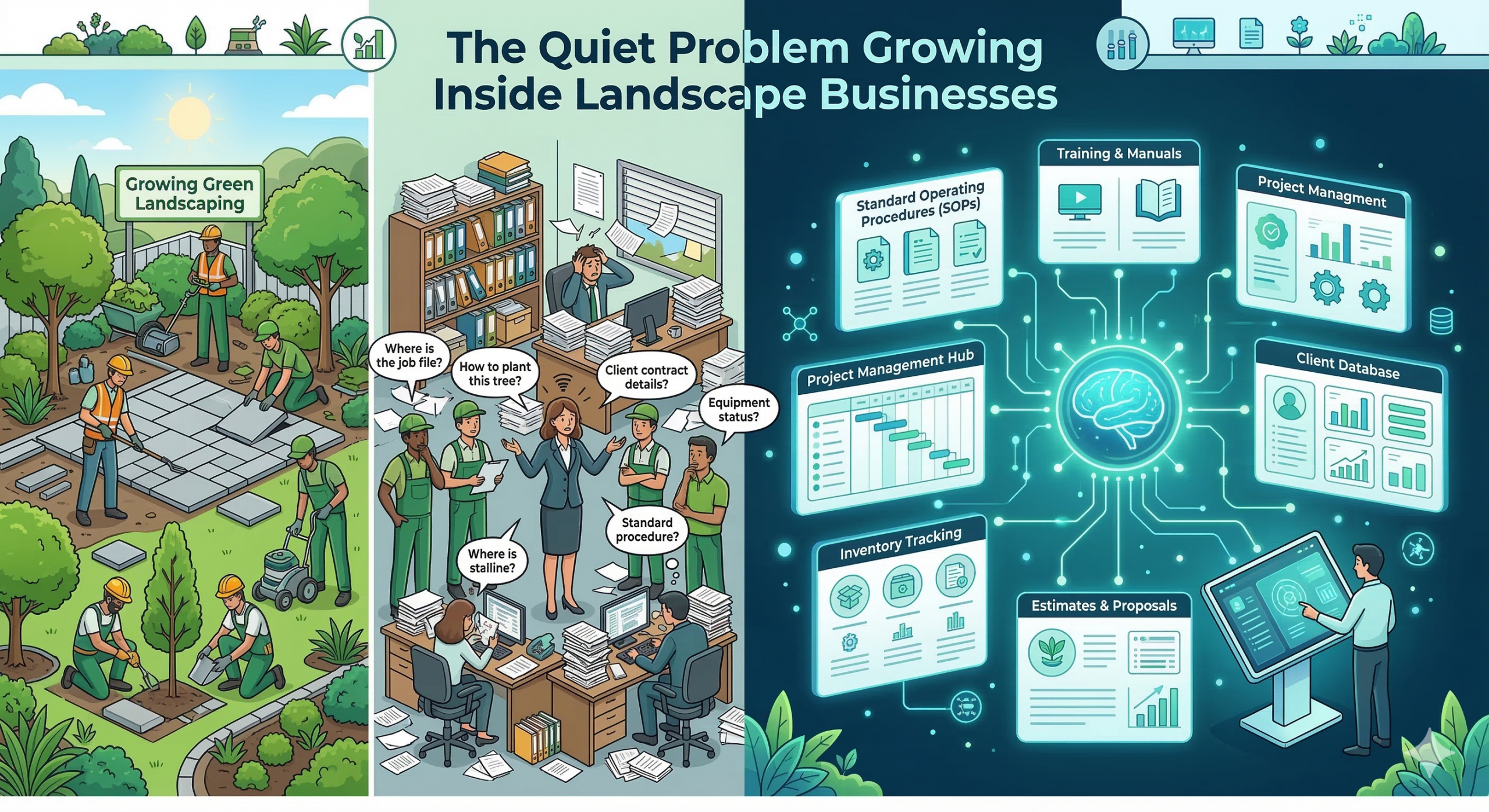
The Real Challenge Isn’t Landscaping—It’s Systems
The primary hurdle for most landscape companies isn’t the quality of the stone laying or the planting; it is the business structure.
Many firms grow organically. A talented landscaper takes on more projects, a team forms, and the owner becomes a “jack-of-all-trades” managing pricing, sales, and problem-solving. The problem? Most of that vital business intelligence exists only in the owner’s head.
When you rely on instinct rather than business automation for landscapers, you hit a growth ceiling. You find yourself:
• Answering the same operational questions daily
• Pricing jobs based on “gut feeling” rather than data models
• Experiencing inconsistent results between different installation teams
Why Standard Landscaping Software Isn’t Enough
Over the last decade, many have turned to landscaping software for scheduling, CRM, and accounting. While these tools are helpful for tracking enquiries, they rarely solve the “systems” problem.
Software records what happened; it doesn’t necessarily dictate how things should happen consistently when the owner isn’t around. To achieve true freedom and scalability, you need an AI operating system—a framework for sales, recruitment, and leadership that functions independently.
From Simple Tools to an AI Operating System
Most owners first experiment with AI for landscape business tasks by using ChatGPT to write an email or a blog post. While useful, the real power lies in embedding AI into your company’s “backbone.”
An AI operating system isn’t a single app; it’s an intelligent structure that supports your pillars of growth:
• Consistent Lead Winning: Qualifying customers 24/7
• Profitable Pricing: Using data-driven models to ensure margins
• Efficient Project Delivery: Documenting internal processes so every team follows the “Gold Standard”
5 AI Systems Transforming the Industry
To implement AI for landscape business growth effectively, consider these five specific applications:
• AI Coach: Analyses business challenges to help owners clarify strategic priorities
• AI Assistant: Handles daily documentation, marketing drafts, and system development
• AI Sales Agents: Responds to enquiries instantly to ensure no lead goes cold
• Custom AI Chatbots: Acts as a “Company Brain,” trained on your specific pricing and services so staff can get answers instantly
• AI Team Dynamics Profiler: Enhances recruitment by analysing behavioural fit and leadership potential
Why This Matters for the Landscape Industry
The craft of landscaping will always belong to the professionals. However, as the market becomes more competitive, the companies that thrive will be those that embrace digital transformation in landscaping.
By using AI for landscape business operations, you reduce the “owner bottleneck.” You create a company that responds faster, operates leaner, and maintains high standards regardless of who is on the job site.